Chapter 10 — Quality and Acceptance
This chapter defines the quality standards, acceptance testing procedures, and performance verification methods for surface water monitoring systems. It covers sensor quality grading, factory acceptance testing (FAT), site acceptance testing (SAT), and the ongoing performance verification requirements that must be met throughout the operational life of the system.
10.1 Sensor Quality Comparison
The selection of sensor quality grade has a decisive impact on measurement accuracy, long-term stability, maintenance frequency, and total cost of ownership. The photograph below illustrates the visible difference between an industrial-grade sensor and a consumer-grade sensor after equivalent field deployment periods, demonstrating the practical consequences of quality selection decisions.
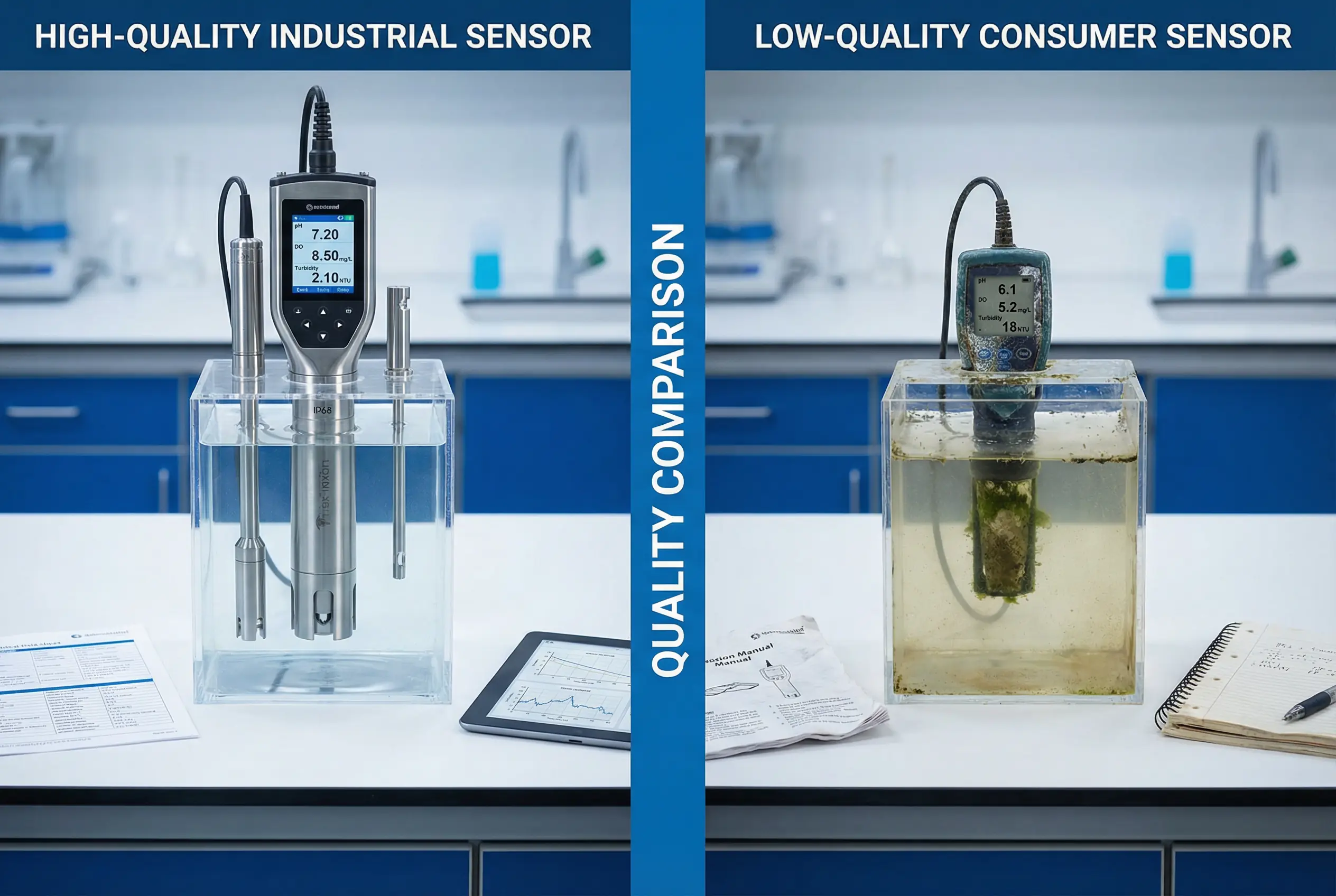
Figure 10.1: Quality comparison — industrial-grade multiparameter sonde (left) showing stable accurate readings (pH 7.20, DO 8.50 mg/L, turbidity 2.10 NTU) versus consumer-grade sensor (right) showing drifted inaccurate readings (pH 6.1, DO 5.2 mg/L, turbidity 18 NTU) with biofouling after equivalent deployment period
| Quality Dimension | Industrial Grade (Class A) | Commercial Grade (Class B) | Consumer Grade (Class C) |
|---|---|---|---|
| pH Accuracy | plus or minus 0.02 pH units | plus or minus 0.05 pH units | plus or minus 0.1 pH units |
| DO Accuracy | plus or minus 0.1 mg/L | plus or minus 0.2 mg/L | plus or minus 0.5 mg/L |
| Turbidity Accuracy | plus or minus 2% FS | plus or minus 5% FS | plus or minus 10% FS |
| Long-term Drift | Less than 0.05 pH/month | Less than 0.1 pH/month | Greater than 0.2 pH/month |
| IP Rating | IP68 (1 m, 30 min) | IP67 | IP65 or lower |
| Operating Temperature | -20 to +60 degrees C | 0 to +50 degrees C | 5 to +40 degrees C |
| Calibration Interval | Monthly to quarterly | Bi-weekly to monthly | Weekly or more frequent |
| MTBF | Greater than 50,000 hours | Greater than 20,000 hours | Less than 10,000 hours |
| Regulatory Suitability | Fully compliant for all regulatory monitoring | Suitable for non-critical monitoring | Research and educational use only |
10.2 Factory Acceptance Testing (FAT)
Factory Acceptance Testing is conducted at the manufacturer's facility before shipment to verify that the system meets all specified performance requirements. The FAT must be witnessed by the client's representative and documented in a signed FAT report. The FAT covers all hardware, software, and communications components of the monitoring system.
| FAT Test Item | Test Method | Acceptance Criteria | Documentation Required |
|---|---|---|---|
| Sensor accuracy verification | Compare against NIST-traceable reference standards in controlled conditions | Within specified accuracy for all parameters | Calibration certificate with traceability chain |
| RTU communications test | Connect all sensors via RS485; verify Modbus RTU polling at specified interval | 100% data acquisition rate over 1-hour test period | Modbus register map; test log |
| 4G/LTE connectivity test | Insert SIM; verify connection to cloud platform; transmit test data | Connection established within 60 s; data received at cloud within 30 s | SIM configuration record; cloud receipt confirmation |
| Power supply test | Measure voltage and current at all supply rails under full load | 24 VDC within plus or minus 2%; ripple less than 100 mV | Power measurement log |
| Alarm function test | Simulate threshold exceedance; verify alarm generation and notification | Alarm generated within 30 s; notification delivered within 60 s | Alarm test log; notification delivery record |
| IP rating verification | Inspect seals and cable glands; verify IP rating certificates | All cable glands IP68; cabinet IP55 or higher | IP rating certificates from sensor and cabinet manufacturers |
10.3 Site Acceptance Testing (SAT)
Site Acceptance Testing is conducted after installation at the monitoring site to verify that the system performs correctly in its actual operating environment. The SAT must be completed before the system is handed over to the client for operational use. The SAT includes all FAT items repeated in field conditions, plus additional site-specific tests.
| SAT Test Item | Test Method | Acceptance Criteria | Pass/Fail Criteria |
|---|---|---|---|
| Sensor in-situ accuracy | Compare sensor readings against grab sample laboratory analysis | Within 10% of lab result for turbidity; within 0.2 pH units; within 0.5 mg/L DO | All parameters within tolerance for 3 consecutive comparisons |
| Data transmission continuity | Monitor data receipt at cloud platform over 72-hour test period | Data availability greater than 95% over test period | No more than 3.6 hours of missing data in 72 hours |
| Alarm delivery test | Manually trigger threshold alarm; verify delivery to all configured recipients | All recipients notified within 5 minutes | Delivery confirmed by recipient acknowledgment |
| Solar power autonomy test | Disconnect solar panel; verify system continues on battery for specified period | System operational for minimum autonomy period at full load | Battery voltage above minimum threshold at end of test |
| Physical security inspection | Inspect all locks, cable glands, tamper seals, and mounting hardware | All security features intact and functional | No missing or damaged security components |