Surface Water Environmental Monitoring Design Guide
(Rivers / Lakes)
A comprehensive engineering reference for designing, deploying, and operating continuous surface water monitoring systems on rivers, lakes, and reservoirs — covering sensor selection, pre-treatment, communications, QA/QC, security, and O&M lifecycle management.
System Overview
A Surface Water Environmental Monitoring System (Rivers / Lakes) is an engineered solution that continuously measures water quality, hydrology, and related meteorological conditions using the pattern: (Monitoring cross-sections / control points) + Online monitoring stations + Data platform + QA/QC & O&M system. It is designed to operate under harsh outdoor conditions — including humidity, insects, algae, sediment, flooding, lightning, and vandalism — and to provide credible, traceable data for water environment management, pollution control evaluation, drinking-water source protection, and emergency response.
The scope of this guide includes on-site sensing, sampling and pre-treatment, station power and communications, central data ingestion, storage and analytics, alarms, reporting, and QA/QC operations. The system is not intended for laboratory-level trace organic quantification (e.g., ultra-low PFAS) solely by online sensors, nor for legal forensic attribution without confirmatory sampling and chain-of-custody documentation.
Key inputs to the design process include site survey data, target parameters and accuracy requirements, sampling frequency, power and network constraints, regulatory thresholds, hydrologic and seasonal patterns, and station security requirements. The system outputs time-series measurements with validity flags, alarms, compliance reports, maintenance and calibration logs, trend and event analytics, and traceable data packages for audits. Typical deployments range from 10 to 300 sites, with sampling intervals of 1–15 minutes, local data retention of 7–30 days at the edge, and long-term retention at the central platform.
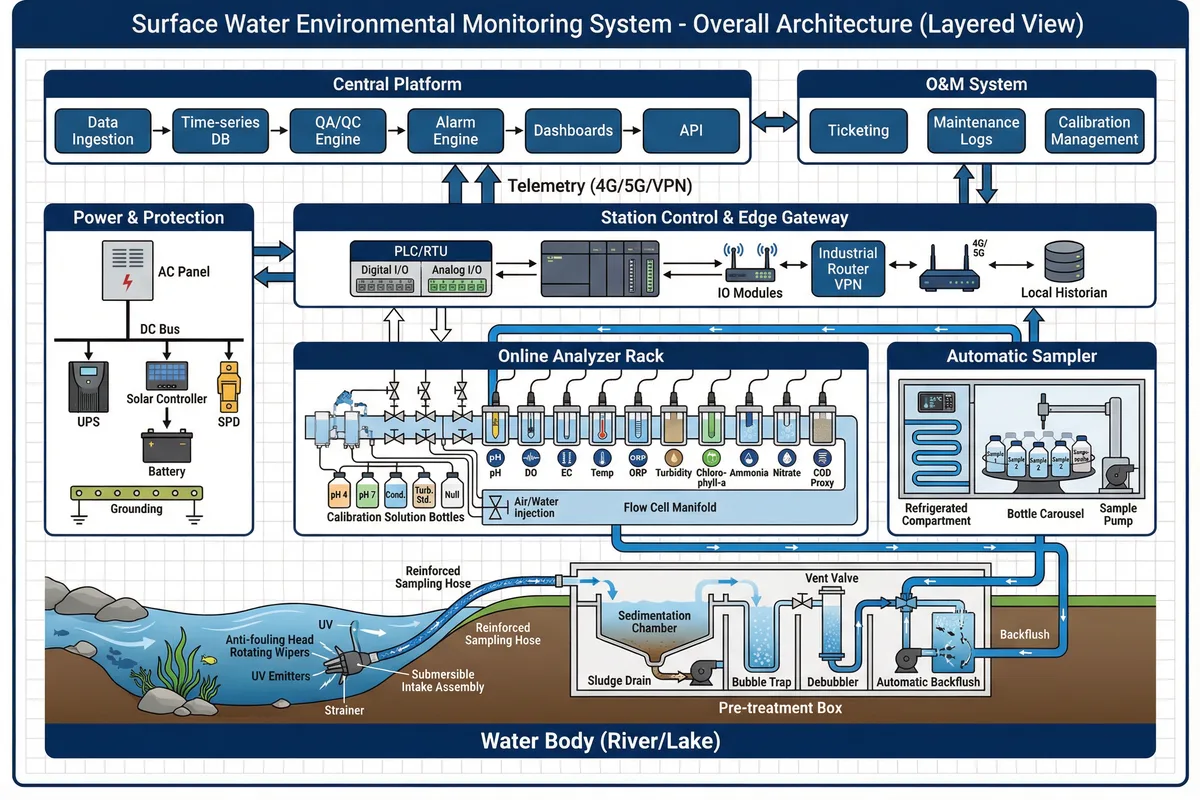
Figure 0.1: Overall system architecture — layered view from water intake through edge station to central platform and O&M system
Main Functions
The Surface Water Monitoring Platform integrates eight core functional domains, each addressing a distinct operational requirement. Together they form a closed-loop system from raw sensor data to actionable intelligence and traceable audit records.
- Data Acquisition & Edge Buffering — Ensures no data loss during network outages through local store-and-forward with configurable buffer duration.
- QA/QC & Validity Flags — Marks suspect data arising from fouling, calibration overdue, or sensor faults, maintaining traceability to maintenance events.
- Threshold Alarms & Event Detection — Multi-level alerts with rate-of-change detection and alarm escalation workflows to minimize response latency.
- Trend Analysis & Reporting — Hydrology-aware analytics that contextualise concentration changes against flow and rainfall, supporting compliance reporting.
- Correlation & Source-Tracing Support — Upstream/downstream comparison, lag analysis, and wind/rain context for reproducible evidence packages.
- Asset/O&M Management — Maintenance plans, spare parts tracking, calibration scheduling, and closed-loop ticketing with full audit trail.
- Security & Audit Logging — VPN, RBAC, tamper alarms, and signed logs ensuring data integrity and regulatory compliance.
- Integration APIs to Regulatory Systems — Standard protocols and APIs with end-to-end data mapping and checksum/acknowledgement handling.
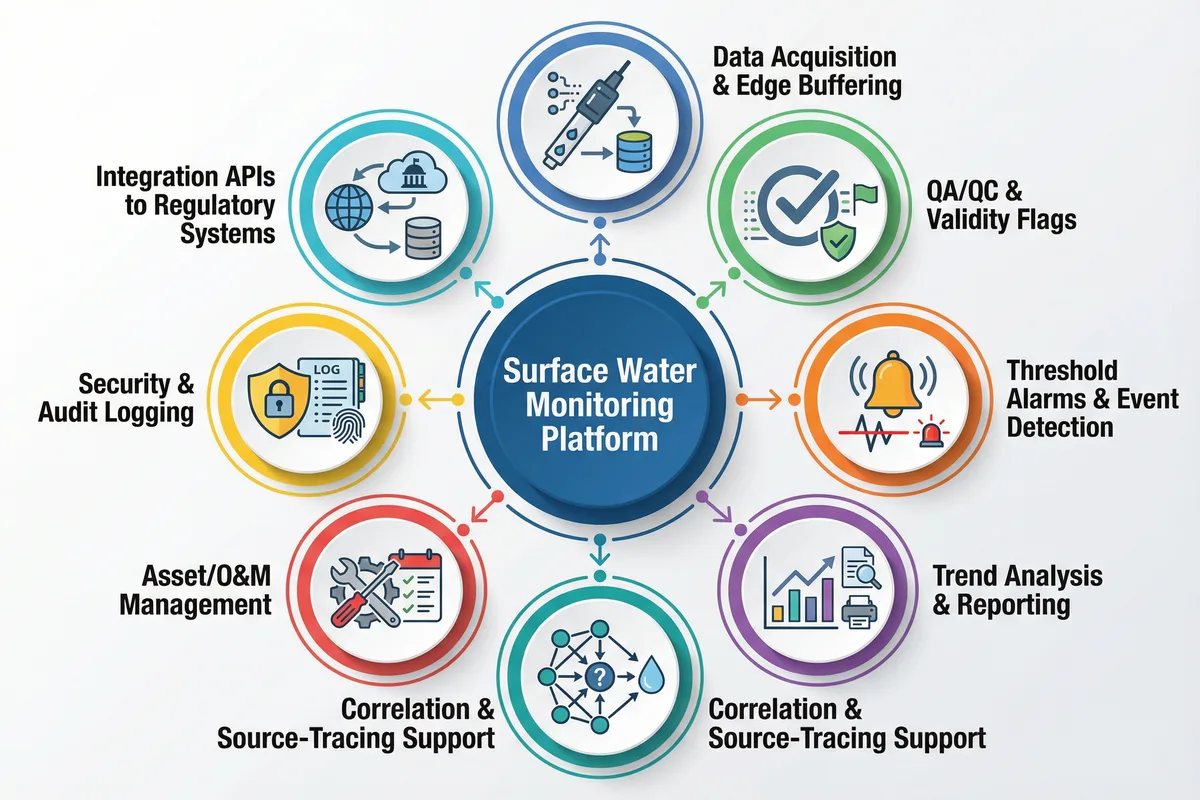
Figure 0.2: Main functions overview — eight core capability domains of the Surface Water Monitoring Platform
Chapter Navigation
This guide is organized into twelve chapters, each addressing a distinct aspect of surface water monitoring system design, deployment, and operation. Use the cards below or the left sidebar to navigate directly to any chapter.
Key Dependencies & Typical Deliverables
Successful deployment of a surface water monitoring system depends on several critical prerequisites and produces a defined set of deliverables that form the basis for commissioning, acceptance, and ongoing operations.
| Category | Key Dependencies | Typical Deliverables |
|---|---|---|
| Civil & Site | Mounting structures, intake pipe, cable routes, flood elevation data | Station layout drawings, civil works specifications |
| Power | Grid availability or solar/battery sizing, UPS for bridging | Power system design, autonomy calculations, wiring diagrams |
| Communications | 4G/5G coverage, Ethernet availability, backup NB-IoT/LoRa | Network topology, VPN configuration, SIM management plan |
| Safety | Lightning grounding, IP ratings, electrical safety compliance | Grounding design, SPD specification, insulation test records |
| Operations | O&M readiness, calibration solutions, spare parts inventory | QA/QC plan, commissioning records, O&M playbooks, BOM |
| Compliance | Regulatory thresholds, data retention ≥3 years, audit logs ≥180 days | Acceptance test reports, data retention policy, audit trail documentation |